Showing posts with label DEA. Show all posts

Monday, 7 April 2014

The Mexican Drug Scene After the fall of El Chapo and the rout of Los Templarios

Rise in Street Crime? Changes in Drug Use?
Do we really know who —or, if anyone— is running the Sinaloa cartel since the surprising arrest of El Chapo Guzman on February 22? And can we know whether the "autodefensa" surge in Michoacan is a citizen uprising headed by good and trustworth leaders who decided they "don't want to take it any more"— or whether it has been a clever maneuver to take-over a drug plaza by a criminal group masquerading as heroes?
Clearly, there is a continuing “manipulation and readjustment” at the leadership level of Mexico's criminal chains, but there is not enough concrete intelligence to arrive at a definitive conclusions about power-struggles in Sinaloa and Michoacán; even less is known about plazas in Edomex, Jalisco and Guerrero. In these last few weeks before Easter 2014, many regions of Mexico might now be described using the same words that Javier Valdez Cardenas used to describe "la Perla Tapatia". His new book (Con una Granada en La Boca) reports the observations of an El Chapo lugarteniente following the death of his boss El Nacho Coronel:
"Todos contra todos, es tierra de nadie. La gente que hemos tenido acá, los parientes de Nacho Coronel, todo se nos vino abajo. Los mataron, los detuvieron, y los otros, los mas recientes, se nos han volteado. Y ahí están todos los cartels y organizaciones nuevas, disputándose la plaza."
"Everyone against everyone, it's a no man's land. The people that we had there, those linked to Nacho Coronel, all have been taken down. They killed them, they captured them, and the others, the most recent arrivals have thrown us aside. And all of the cartels are there and the new organizations – all fighting for the plaza".
The fact is, we do not know who is in charge of the Sinaloa cartel or who may be giving the orders. Neither do we know who has the advantage and control in Michoacan. We know that at least six groups are competing for the plaza in Edomex (http://www.proceso.com.mx/?p=367307) — but can't be certain which is dominant.
However, there have been developing trends indicating a shift in the drug market — in particular, reports of major differences in the "product" that is shipped and consumed both in the USA and within Mexico.
Miroff describes an increasing heroin use, and perhaps a weaker marijuana market for Mexican "mota" in the US. Perhaps this is one consequence of El Chapo's take-down — Marijuana is a “stable cash-crop” and “income staple” of the Sinaloa Cartel (primarily shipped through the tunnels of Arizona from Nogales to Agua Prieta), and marijuana supplies the payroll for much of El Chapo Guzman’s organization. Marijuana shipments may have been disrupted —in response to the changing demand in the market (unlikely), to a new competition within the US markets taking advantage of "legalization", or perhaps as a result of confusion and uncertainty within the Sinaloa distribution network.
There is also evidence a shifting consumer market within Mexico according to Proceso (#1953 —Manzanillo, más caliente que nunca ). Proceso attributes an increase in domestic consumption of synthetic drug to the plaza battles between Los Templarios and the Cartel Nueva Generacion de Jalisco. This report reports that the port city of Manzanillo has now "heated up" ever since the Cartel de Jalisco Nuevo Generacion (CJNG) decided to focus the internal Mexican synthetic drug market.
Any adjustments at the "top of leadership level chain" and the long-term changes in the distribution patterns and consumer tastes should become clearer over time. But what is even more chaotic and difficult to control are the changes affecting the bottom end of the drug underworld. The crime on the street will remain unpredictable, chaotic and dangerous until the adjustments at the top reach a new equilibrium.
The chaos at the street level and in the lower echelons of the drug trade is becoming more evident and has been described in a few Spanish language reports. The payroll (la nomina) of several organizations has been severely disrupted, and as a result the entry level apprentices and hangers-on  — "los halcones”,“enforcer squadrons”, and "goon enforcers" are not assured of a regular "sueldo"  (bi-weekly payments) nor can expect "bonuses" for jobs well executed. The result —rising trends in petty crime (robberies, car-jacking, strong-armed extortion, and kidnapping. The widely publicized attack on a Noroeste Director may be one example of this fall-out (e.g. http://www.noroeste.com.mx/publicaciones.php?id=939364 ). Proceso edition #1953 also has a report describing the rise in extortion, robbery, car theft and other street crimes throughout Tamaulipas suggesting that it is the bottom feeders of the cartels who have been left without a steady source of income (En Tamaulipas, violent recaída)
It will take time to understand how things have resettled at the leadership level, but in the short term I expect to see a significant increase in called routine street crime and random violence. Without a stable leadership who are firmly in control, thousands and thousands of young hoodlums have no expectation of a regular salary. Many Mexican communities can expect increases kidnapping, extortion and robbery. And I expect that this will happen in the cities that have been previously been safe and described as "sanctuary cities".
We must remember that "capos" and high level operators employed "squadrons" of lower-level thugs to "keep the lid-on" local communities and gave them directives to sanction petty crime. And in some cases (Tamaulipas and Nuevo Laredo), they used these lower-echelon thugs to create confusion and public mayhem. Many who have have written about this, but one of the most detailed descriptions is found in Javier Valdez's new book where one chapter focuses on a member of one of these lower end "squadrons": Valdez describes the criminal life of Juan, a low-level enforcer whose primary task was to "sanction" anyone who perpetrated a crime on ordinary citizens in Culiacan. Juan describes one assignment where he was ordered to hunt down, torture and kill three young guys who kidnapped someone. Juan and three companions— all under 20 years old — carried out their task with a brutal efficiency that included feeding one of the kidnappers to a crocodile and dousing the partially eaten victim with cocaine. Valdez asks Juan if he feels bad about this, but he reports that feels no remorse or moral quandary. His only concern was whether he would be receive his regularly bi-weekly payment in the coming week.
Unfortunately, routine street crime is likely to increase over the next few months during this period of leadership instability and it is ordinary citizen who will suffer the consequences.  And in the absence of "capos" in clear control, there will be no-one to defend the ordinary man or woman — and they never had confidence in the police. The fact is, the police are more likely to join in and exploit them if they believe that there is no "chief of the plaza" watching them.

April 7, 2014

Saturday, 13 April 2013

What's wrong with El Blog del Narco? What is its importance in Mexico?


Truth be told, I've never relied on Blog Del Narco as a primary source! I routinely monitor several of Mexico's national newspapers (El Universal, Milenio) and focus on sources that I personally trust ( Reforma, La Jornada, and Proceso). Furthermore, my personal interests are Sinaloa-centric and I depend on regional papers and magazines (Noroeste, Rio Doce and El Debate) .

More recently, Twitter feeds and Facebook groups such Carmen Aristigui's and those of journalists and columnists have been invaluable sources.

And of course, several international English language sources sit on my personal "must review list". This list includes the New York Times, The Los Angeles Times, the Arizona Daily Star (Tucson), the Guardian, the BBC, and Al Jazeerah.

I treat most blogs as "collector sites" with a few exceptions – for instance Bill Conroy's The Narco News Bulletin generates original investigative reports. Most blogs are personal review essays that rehash current news and convenient gateway sites that contain links to primary documents and sources. If a blog mentions an original source of interest, I track down the original and archive it after reading it.

Do I believe that Blog del Narco is original source of news not reported elsewhere? 


No way! Perhaps it once was - but there is not enough original reporting to justify the claim of originality or uniqueness. Given previous threats and acts of violence against bloggers in Tamaulipas, it may well be that El Blog del Narco's correspondents went into a deep retreat and are now silent. But I have always wondered how"in the field" journalists routinely made contact with Blog del Narco without being traceable or discoverable. The possibility of being discovered would discourage anyone from sharing information with Lucy and Blog del Narco. It also seems to me that el Blog del Narco lacks the technology and sophistication to protect trusted sources with secure firewalls and the multiple re-routing of messages via international servers that anonymously bounce emails to delete IP trails.

Perhaps El Blog del Narco did originally post information from local correspondents.  And perhaps those sources also realized that local news could more efficiently and anonymously disseminated using twitter and other short txt and image transmissions. Local sources may have seen less value in sending breaking news to distant sources and less danger with a more direct payoff in tweeting or texting to local followers.  Without a steady stream of local correspondents, El Blog del Narco would not be capable of delivering news except as a "gateway" model relaying reports from regional and local periodicals.

So why hasn't Lucy la bloguera acknowledged original sources and includes links to that source? If local correspondents were in a danger zone, there clearly is a justification for not providing any identification or links traceable back to those reporting directly from danger areas. But what justification is there for not including links when information has already been appeared in print and where the reporter or correspondent has already been identified? I can't speak for her personal reasons for not including those links, but I can suggest at least three good reasons why it might be reasonable to leave out identification from posts.


First, there a very real climate of fear surrounding the publication of any narco-news and direct threats to publishers (mainstream and informal) are well documented. When a threat is generalized and vague it must taken seriously in Mexico. Warnings and threats are not always blatant in-your-face encounters, but frequently rely on implied danger and harmful consequences. In northwest Mexico, even the slang code word to warn of impending danger, - "agua", is as vague and indirect as most threats.  Implied threats can carry more weight and be even more frightening than direct confrontations. But clearly, the warnings also take concrete form - News outlets have been routinely bombed, reporters have disappeared, reporters are murdered, and direct warnings are regularly conveyed to anyone who posts reports about crime and corruption that criminals and others do not want to see in print. Those threats, whether specific or generalized, can come from anywhere— narcos, politicians, police and the army. We should recognize that Lucy la bloguera is operating in a climate and a context where everyone does think twice about what they say in public, and they are even more cautious about what they put into words. Trained journalists understand this code and recognize the danger, and they are always aware of how far they can go in reporting a story. Basically, the argument here is that el Blog del Narco appears in a climate of clear and imminent threat and the code for reporting crime and violence is ambiguous and amorphous as a stream of water or a murky pond.

Second,  there is concrete evidence that the larger cartels are really monitoring the news and the internet! They ARE monitoring what appears in print and online. I've been told directly about phone calls from narcos made directly to the authors of an article that appeared in obscure blogs warning them to be careful. The number of hits that el Blog del Narco receives makes Lucy a very likely target for warnings and threats. And of course, it is also 100% likely that she has received stories and information directly from one DTO or another. We may find it difficult to believe that this level of monitoring or direct pressure happens, but the reality is that it does. It is true that the fact of monitoring by narcos doesn't directly answer the question of why el Blog del Narco doesn't cite sources, but it does illustrate clearly that journalists and bloggers in Mexico are operating under a different set of conditions than we do on our side of the Rio Bravo and the Mexican border. We are happy when our blogs and notices are watched, and we don't worry that they might be watched by people who are capable of hurting us or a family.

The third reason that el Blog del Narco might have left out links is much more mundane. Originally, I posted information to this blog site by scanning articles daily and posting a short description of the news a link back to the original source. I also classified articles into categories such as Human Rights Violations, Corruption, Los Zetas etc. I can personally testify to the fact that undertaking to collect so many regional reports and news items and converting them to formats to post is both time consuming and tedious. And I can testify that there is a lot of work involved in tracking links and making certain they are correct and are working. Adding the references and the links to the items was the most time consuming and problematic part of those posts. Most charitably, I might be willing to accept that Lucy and el Blog del Narco didn't allocate the time to take that final step of verifying links— but I do admit that this is not a convincing argument in her defense. I think that the first two reasons I suggested are much more convincing reasons for doing things on the fly.

Does el Blog del Narco serve a purpose? 


I personally give it 2 thumbs up in this regard! Few have the luxury of time and personal training to scan many sources and develop informed judgments about which sources are reliable. But the broad narrative of violence in Mexico does require telling and it does demand a broad voice that speaks to all of the violence across the nation. El Blog del Narco does serves an important purpose as the national town crier. In many ways, El Blog del Narco disseminates news akin to the way that corridos and narco-corridos pass along information and details to the Mexican everyman.

Should Blog del Narco acknowledge its sources?


Definitely — but I also think that it is unreasonable to demand that the editor apply the same standards that we on this side of the border use to judge academics and trained journalists . A broad disclaimer and acknowledgement that Blog del Narco borrows material would go a long way to providing it with more credibility! But this would only be a token acknowledgement, and the fact is that anyone who routinely scans Mexican news reports already recognizes that reports in El Blog del Narco are from elsewhere.

Is Blog del Narco unique in Mexico in borrowing and sharing news reports? 


Far from it! On one hand, many Mexican news outlets routinely reprint and report other sources and reprint columnists who have published in other papers and magazines. Of course they also acknowledge the authorship, even if they rarely provide links to original sources. And unlike el Blog del Narco, I also assume that they pay a fee or have a shared arrangement. We should also remember that politicos in Mexico have historically interfered with journalistic integrity and disrupted the reliability of news by releasing reports and press releases that ares blatantly propagandistic or contain baldfaced lies. They applied coercion by using strategies such as blocking newsprint delivery or they simply paid a co-opted journalist to write only favorable story. Few people seem to remember that once upon a time La Jornada distinguished the real news by printing it in  normal font while publishing all questionable reports  (government releases) in italics. And of course, they have even resorted to buying up or destroying all copies of papers that contain unfavorable stories: there was an example of this yesterday in Chiapas ( “Compra masiva” de ejemplares de diarios de Chiapas que critican al gobernador")

Rocha: Proceso 1902-
Zanahoria Garrote
http://www.proceso.com.mx/?p=338943
Given this cultural context and history of journalism in Mexico, El Blog del Narco must be seen as just one of many "news" outlet/sources that is operating under subterranean values that condone questionable practices and carelessness through fear or by custom. 

Should we really be bothered over the allegations that Blog del Narco does not use original material and that it does not acknowledge this practise? 


I personally don't think so, but I do acknowledge that it's not my material that is being used and reprinted. I have personally had material used without acknowledgement and for profit by unscrupulous journalists who "borrowed it". That's why this narcocartels.com blog site has faded away - but unlike El Blog del Narco, my musings and research were used by individuals who hoped to gain a substantial profit. In the case of Blog del Narco, I can't see how someone has profited (...yet?). 

One thing that strikes me in this emerging controversy is how journalists within Mexico (see the Al Jazeerah broadcast http://www.youtube.com/watch?v=qgcPZ-ta-y4&feature=youtu.be) are not as vocal nor concerned about charges of plagiarism as are bloggers on the other side of the Rio Bravo. In the Al Jazeerah broadcast Lydia Cacho recognizes that El Blog del Narco does not represent "true journalism", but she also argues that El Blog del Narco plays a very important role in raising general knowledge about narco violence, corruption and abuses of human rights within Mexico.


 The fact is that most complaints directed toward El Blog del Narco are coming from outside of Mexico and fewer voices are heard from within Mexico. It seems to me that at least some of the discomfort about Lucy la bloguera y su plagio is one more example of foraneos imposing a narrative onto a Mexican issue. And problematically, that conversion of the narrative twists the focus of attention away from the real problems faced by Mexicans.


For more information about the criticisms of El Blog del Narco: see http://themexpatriate.com/2013/04/12/anonymous-chronicling-the-drug-war-in-cyberspace/

In my other (academic) life, I do not tolerate plagiarism. I have taken steps that had severe negative consequences for students and colleagues who engaged in academic dishonesty. If I were reviewing the work of El Blog del Narco in a professional capacity, I would have submitted every edition of Blog del Narco to "Turnitin.com" and refused to publish any issue that demonstrated unacknowledged citation. I would have gone further and forwarded the details to academic integrity committees for sanctioning. But in the case of El Blog del Narco, we also need to acknowledge that it appears in a nation where news is routinely and blatantly manipulated in perverted Gramscian demonstrations of arrogant power.

Hopefully, narco violence in Mexico will one day diminish to a point where every citizen will also have the luxury and time to debate good manners, the ethics of acknowledging others, and the need to respect those who risked danger to produce their stories. But Mexico is not there! 


I do believe that the concerns about the authenticity and legitimacy of El Blog del Narco are more important outside of Mexico. I also believe that this asymmetric outrage has not been fully recognized during this rush to point fingers, vocally pursue allegations of plagiarism and counteract claims of la boguera Lucy.  This asymmetric outrage and indignation is another example of how we anglo-northamericans (I hesitate to use the word gringo since I am Canadian) appropriate the reality of other lives and convert it into our own issue..

Believe me, I am far-removed from cultural sociology and my academic training led me to trust empirical and quantitative methods rather than cultural critique and deconstruction of narratives. But, it seems to me that this vocal outrage against Blog del Narco is an example of our appropriation of a Mexican issue and our conversion of the narrative into one that matters more to us than it does to a Mexican.

We have frequently appropriated the Mexican experience and recast it through a WASPish[1] lens. There is a terrific book by William Francis Deverell documenting how Mexican experiences and cultural traditions in Los Angeles were reconstructed into an anglicized narrative to convert the region into a culturally acceptable  southwestern uniqueness that had more appeal to American nativists than it did to Mexicans. (Deverell, W. F. (2004).Whitewashed adobe : the rise of Los Angeles and the remaking of its Mexicanpast. Berkeley, University of California Press.).  We've long borrowed "select" Mexican cultural traditions and recast them as an anglo narrative: Cinco de Mayo is probably the best example of a hybridized cultural event that expresses Anglo visions more intently than it does Mexican history, and the Day of the Dead celebrations are another example of changing the Mexican experience into a specific Anglo vision of Mexico by filtering out the Mexican elements that don't appeal to us.

What does this argument of cultural appropriation have to do with complaints about Blog del Narco?


For all its imperfections, el Blog del Narco represents a voice that must be heard! There is a power in the message of El Blog del Narco that cannot be denied and that should not be quieted. It reaches an audience that has not been touched by traditional journalistic outlets! Who are we to warn Mexicans that they must tell a story according to our rules of journalism and our academic ethics? Doing so will leave the story untold, and that's what the government of Enrique Peña Nieto wants to happen.


RECOMMENDED: A report released by the World Association of Newspapers and News Publishers (WAN-IFRA) and the International Press Institute (IPI) following their February joint press-freedom mission to Mexico states that the new Mexican federal government must work to fully implement recent institutional measures designed to improve journalist safety. LINK TO ENGLISH LANGUAGE PDF OF REPORT IS http://www.wan-ifra.org/system/files/field_article_file/Mexico%20Final%20ENG_0.pdf

LINK TO SPANISH LANGUAGE WAN-IFRA NEWS RELEASE IS http://www.wan-ifra.org/es/articles/2013/04/15/gobiernos-estatales-uno-de-los-principales-obstaculos-para-la-libertad-de-prensa


[1] I am thinking that I will begin to use Jared Diamond's term WEIRD – Western, Educated, Industrialized, Rich and Democratic in the future. It's from his new book "the World UntilYesterday" and does seem to better describe the cultural clashes that are at play here. 

Tuesday, 28 August 2012

Mexico is burning, but who is watching...


Felipe Calderón's drug war is looking more and more like a whack-a-mole children's and carnival game of chance. This is an appropriate analogy — given that it's a time for State Fairs and it is the final summer weekend before tschool begins. Wherever he sends the army, marines and or Genaro Garcia Luna to bat down a narco, another pops up somewhere else. And even worse, they are popping out of more and more holes — and some of them are even "moles" of another sort.

After a horrendous weekend of violent incidents, pitched battles and widespread bloodshed throughout Mexico, it's even more difficult to take Felipe Calderón at his word when he claims that things are getting better in the drug war. And other events during the past 10 days make it even more risible when examined alongside several optimistic reports that encourage business investments and promote a get back-to-business-as-usual viewpoint: Even an otherwise good Washington Post report nevertheless leaves the impression that the war is coming to an end in Cd. Juarez (http://www.washingtonpost.com/world/the_americas/in-mexicos-murder-city-the-war-appears-over/2012/08/19/aacab85e-e0a0-11e1-8d48-2b1243f34c85_print.html) and a Forbes/Global Post is even more enthusiastic about the potential for a new business boom in Juarez (http://www.globalpost.com/dispatch/news/regions/americas/mexico/120822/mexican-economy-juarez-exports-outsourcing-multinationals-business?page=0,0 and http://www.forbes.com/sites/nathanielparishflannery/2012/08/27/why-is-mexicos-murder-city-attracting-investors/). And even when those news stories about Mexico manage to make it into print, most of them ignore or downplay the bloodbath that continues and is far from being abated

Perhaps many reporters don't have time for fact checking, or a few are naïve and have been victimized by the deliberate and well-orchestrated public relation campaign to speak only well of Mexico  and convince the world that drug deaths are declining and only "about 50,000" even though Mexico's official statistical agency (INEGI) reports  more than 27,000 murders last year, and almost 107,000 during the first five years of Felipe Calderón's term.

And things are even worse than these INEGI numbers indicate. There is evidence that INEGI data under represents the true number of homicides (cf "Desconfían del SNSP", Rolando Herrera, Reforma 18-Ago-2012). Neither are there statistics to verify the estimated count of 10,000 or more who have simply disappeared from the face of the earth. And sadly, there are no true counts for the number of people who abandoned Mexico and fled for safety and sanctuary north of the Rio Bravo.

With the exceptions of discussions on google groups such as fronteralist or posts from informed bloggers (e.g. http://theragblog.blogspot.ca/2012/08/tom-hayden-javier-sicilias-caravan-for.html ), there has been little notice of the Caravan for Peace march to decry the outrageous levels of violence in Mexico and the uncaring treatment of the narco-war victims.(see http://www.proceso.com.mx/?p=318167)  Unlike the American press and media, France's "Le Monde" boldly describe what is really happening and lamented the  lack of global attention  in a hard-hitting editorial — "Mexique, la spirale de la barbarie". (http://www.lemonde.fr/idees/article/2012/08/23/mexique-la-spirale-de-la-barbarie_1749042_3232.html).

10 days of barbarity: Some of the events during one week of this Mexico that "turned the corner" toward peace.


Several optimistic reports (English language) about Mexico have appeared in the past few weeks and many of them reported the 50,000 casualty figure. Even reports that were intended to be sympathetic, have used this 50,000 number as if it were fact. Meanwhile, these are some of the other horrorific events in Mexico during last week that scarcely rated a notice north of the border:
  • 11 people were executed and narco messages left on their corpses beside a highway in Guerrero that leads to the popular resort communities of Zihuatanejo and Ixtapa (http://www.lemonde.fr/idees/article/2012/08/23/mexique-la-spirale-de-la-barbarie_1749042_3232.html)
  • The bloodiest major cartel (Los Zetas) appears to be fracturing amidst an internal and brutal fight for turf. Long time leader and founder Heriberto Lazcano Lazcano ("El Lazca) is being challenged by the even more brutal Miguel Angel Treviño (El Z-40) . There are bloody, inhumane and horrrendous consequences that have been documented by both the Zetas and by others (http://www.blogdelnarco.com/2012/08/decapitan-al-comandante-charro-de-los-zetas-en-zacatecas/ and http://www.blogdelnarco.com/2012/08/lucha-al-interior-de-los-zetas-en-varios-estados/#more-14409) Also see http://www.proceso.com.mx/?p=318153
  • Elements of the Mexican Federal police reportedly captured the leader of the New Generation of the Cartel of Jalisco (with alleged links to Sinaloa) and unleashed urban chaos. The arrest of Nemesio Oceguera Cervantes "El Mencho" was followed by at least 22 narco blockades in the Guadalajara area. Buses, vehicles and trucks were burned and blocking streets in Mexico's second largest city. (see http://www.blogdelnarco.com/2012/08/detienen-a-nemesio-oceguera-cervantes-el-mencho-y-causa-22-narcobloqueos/ ). And a later report indicated that the police were mistaken — El Mencho wasn't captured even though everyone thought that he had been. (http://www.proceso.com.mx/?p=318298)
  • Another turf war involving the Caballeros Templarios and Jalisco New Generation resulted in at least 17 executions and the widespread posting of narco messages and warnings throughout Michoacan .(http://www.proceso.com.mx/?p=318158)
  • The weekly newsmagazine Proceso reported a confrontation involving unknown forces and army forces in Mexico State that left an estimated 30 "sicarios dead". (http://www.proceso.com.mx/?p=318139) The official death report is lower, since no bodies were left the site. Only hundreds of spent cartridges and bloodstains remained as evidence of the skirmish. Eyewitnesses report that the bodies were retrieved by survivors of the shoot-out.
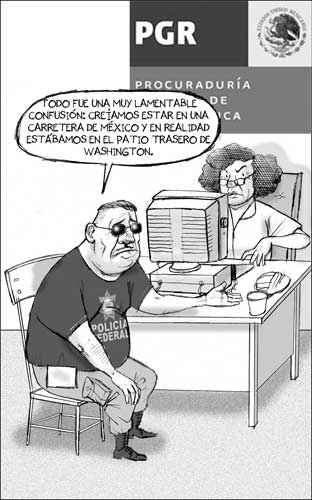
  • There was an ambush and attack directed at an US embassy vehicle driven by a Mexican Marinero. The driver and his passengers — 2 men linked to the US embassy and a mysterious 4th person who was rumoured to have been a protected witness providing information about Beltran Leyva cartel operations in the area. Proceso (#1859) immediately reported that the two Americans were not registered diplomats and claimed that they were DEA agents (http://www.proceso.com.mx/?page_id=278958&a51dc26366d99bb5fa29cea4747565fec=317968). Later reports identified these two wounded survivors as CIA agents (see La Jornada http://www.jornada.unam.mx/2012/08/28/politica/005n1pol). Fortunately for everyone in the embassy vehicle, it was "blindado" and "bullet-proof" to level 7 (the highest possible armour and bullet proofing available). Twelve Federal Police officers were arrested and remain in detention in Cuernavaca. Their families claim they had been acting under orders and they have filed a protest and complaint about their relatives treatment with the National Human Rights Commission. 

These are just some of the of events from the past 10 days, and the level of violence reported in these examples makes it unimaginable how anyone might conclude that Mexico has turned the corner and is ready for the return of international investment and normalcy.

Furthermore, there are far too many outbreaks of violence within such short time-frame to treat these as isolated occurrences that are unconnected to a larger political and economic context. Something bigger is going on, but at the same time there are too many different dynamics at play to suggest that there is only one thing going on. We can only guess about the big picture, and must be content to offer impressions about what might explain this recent rash of violence.

Many of these incidents are indicative of a renogotiation of business "partnerships" and realignments that always occur during presidential transitions. Mexicans speak about the year of the Hidalgo (Hidalgo's figure is on the 1947 issue 5 peso coin and the modern 1000 peso bill, http://www.sandiegoreader.com/weblogs/fulano_de_tal/2011/jul/14/the-year-of-hidalgo/ ) when they try to explain the mysterious personal enrichment that happens during the last year of a sexenio, and it is very probable that there is a narco-equivalent to the year of Hidalgo that results in a mad scramble and period of chaos not unlike those seen in Gold-Rush frenzies or the rush to claim land when territories are opened to those who get their first..

That is, many of the skirmishes and battles described above are probably about claiming, staking and preserving turf. Violence is a necessary and symbolic demonstration that someone has the huevos to control the plaza or to take it over. The escalating casualty count is the consequence of their strutting, and uncontrolled brutality  is represents both a threat to others and a reaffirmation that someone is strong enough to be the boss. Remember, there will be major bureaucratic change in the upper levels of most institutions in Mexico, and all external connections to bureaucratic power must be renegotiated; the narcos, the money launderers, the politicos, the police, the military, customs agents, border agents, air authorities or anyone else who wants to retain their to stake out an institutional turf in Mexico will be doing whatever it takes to preserve their place. With the return of a PRI president it is even more likely that there will be a wholesale bureaucratic switchover to placate PRI loyalists and place them in positions currently occupied by the true believers of PAN (...although many PANistas have been converting).

I don't think that this institutional reshuffling and realignment will affect all areas and States in the same way.  Not much may change in Sinaloa (which had no governor election), but changes will definitely impact other territories that are permanent fixtures in the drug scene, and will also affect other areas that had gubernatorial elections (Guerrero, Michoacan, Vera Cruz). Institutional realignments are also certain to leave the greatest impact in those regions that emerged as fracture points and contested plazas during the last half of Felipe Calderón's sexenio.(Coahuila, Nuevo Leon, San Louis Potosi and even Guadalajara itself) 
.
Perhaps another possibility for explaining this recent surge in violence is that they have been triggered by initiatives related to the US election and American politics. After all, think of the beneficial bounce to be gained by finally capturing El Chapo or any of the other big capos. Might it be the case that the DEA/CIA was turned loose with the blessing, encouragement and full cooperation of Felipe Calderón. If such operations are successful, President Obama would be able to showcase another bad guy brought to justice , and Felipe Calderón could ride into the sunset (or the University of Texas) and boast that he was in charge when El Chapo was finally captured. This is a less likely explanation for all of the violence that is occurring, but is a scenario that should never be dismissed in the land of magic realism led by a president hoping for a miracle to salvage his reputation. Furthermore, this scenario is believable given that the US political administration has begrudgingly acknowledged that there might be a "hit list" that allows the takedown of enemies of the State. Perhaps it is not farfetched, and maybe there is a justification for believing all of the rumours and reported increase of DEA and CIA agents in Mexico and Central America as part of the "Obama Policy". (see the review of Sanger's "Confront and Conceal" at http://www.nybooks.com/articles/archives/2012/aug/16/obama-abroad-report-card/)

More specifically, the ambush on the road to Cuernavaca (Tres Marias) must certainly be connected to recent incidents and the dismissal of federal police from their assignments at Benito Juarez International Airport (http://www.jornada.unam.mx/2012/06/26/politica/003n1pol and http://www.jornada.unam.mx/ultimasal /2012/08/19/112057506-reasignan-policias-federales-del-aicm-a-otras-areas-seran-201cnuevos-agentes201d-los-que-atiendan-la-seguridad-en-la-terminal). The shoot-out between fellow agents in the Federal Police in the middle of Mexico International Airport is evidence that there are competing factions within the PGR and Federal Police agency. Who knows whether the Tres Marias ambush and attack was a deliberate maneuver by corrupt Federal Police, or whether it was carried out by colleagues who had been set up to be stooges by "colleagues" who were directly feeling theheat form the Benito Juarez shooting and and the firings and reassignments in its aftermath.

From Fisgón — La Jornada, Aug 28
In fact, we don't know where those airport police were "reassigned" after the airport incident.  Were any of those reassigned to the Tres Marias area? What happened to the uniforms and guns of those who were sacked? Where are the 29 Federal Police who were reported missing in the aftermath of the firings?

Personally, I suspect that those Policia Federal on those backroads near Tres Marias were stooges who were set-up with incomplete,false or misleading information — that's a common modus operandi in the byzantine political world inhabited by denizens at the upper echelon drug trade. "Machiavelli for narcos" is really a bible for those involved, and the Tres Marias incident has more twists and turns than found cumulatively in both seasons of the Borgias.

Meanwhile, bodies are piling up and disappearing before they can be retrieved by the police and the army and counted by authorities. Los Zetas and its military code "to leave no one behind" suggests that they were certainly involved in that 30-reported-dead shoot-out and missing bodies in Edomex, and the increasing rumours of an internal dispute between El Lazca and El Z-40 make that an even more likely scenario. And authorities in Guadalajara are left to figure out how to get traffic moving and look for funds to replace the burned out buses and government vehicles destroyed in the 22 blockades.

Almost no one in the english language press is paying attention to these incidents of violence, nor are they providing widespread coverage to Javier Sicilia's march for peace and justice that has included events such as the destruction of AK-47's and visits to gun markets to directly demand that gun merchants refrain form shipping weapons to Mexico.

I have a sickening sense of foreboding that the next two months will continue in much the same way as last week, and the world may not be watching. After all, it is is the year of Hidalgo and a time for self-preservation and enrichment.